Wednesday, September 22, 2010

Astrological Spirit of a City


I was just asked where to find instructions in obtaining the guardian/angel astrological spirit governing a particular city.

From an astrological standpoint you would go about this in the same way as you would with any chart, normally we think of natal charts for this, but you can get the name of the spirit of any moment, by looking at the chart for the time, date and place.

I use Agrippa's method from Three Books of Occult Philosophy, Bk III Chapter 26. Very interesting that yesterday, I put this chapter up on my website! I am currently working on my new Traditional Natal Astrology Course and am including some magical natal astrology as part of the course.

Basically I use the "Arabian" method in which you assign a letter to each degree of the Zodiac starting with 0 Aries. Another method that Agrippa describes is starting with the degree of the Ascendant, but then this would vary for every chart.

Then we determine the five hylegical places. These are used in natal length of life calculations and are the degree of the Sun, Moon, Ascendant, Part of Fortune and prenatal syzygy. The prenatal syzygy is the New or Full Moon immediately preceding the chart date.

We take the degrees, find the letters that correspond and this is the name of the spirit of that particular time, date and place. Quaero Lux has a special online daimon name calculator I kept getting different English results until I realized it didn't have J, V or W, following Latin spelling.

The problem for a city is that sometimes we don't know the date, but even more problematic is the time, that a city was founded. For example, Iowa City, IA, my location, was founded on May 1, 1839 and had to be founded before midnight legally, so officially it was founded at 11:55 pm, but the account then says that dawn came early!

Of course, this is not the only method. Our illustrious predecessors would have also used dreams and visions, plus direct contact with spirits to obtain this sort of information.

It's interesting but I've often speculated that the angel of America, likely a Dominion or at least Archangel in the Celestial Hierarchy attributed to Dionysius the Areopagite, looks like the Statue of Liberty, "give me tired, your poor..." while the demon or fallen angel of America has the head of an eagle, a sort of Assyrian mailed body and is clutching the 13 arrows like the US seal, but they are dripping with blood.

Tuesday, September 21, 2010

Deneb Algedi Mirrors & Talismans


I was very pleased with our recent Deneb Algedi election! I had my best mirror etching yet, thanks to help from my wife Kathleen, with the stencil cutting. I got a real sense of peace and contentment from doing this election. We had a lot of participation from Spiritus Mundi members and a lot of Deneb Algedi talismans made.

I wanted to mention that we now have Deneb Algedi small and large mirrors available! Deneb Algedi is the Tail of Capricorn, excellent for peace, particularly in the home, safety and "increase of wealth" And seriously folks, as much as I like wealth, I suppose peace, particularly peace of mind is what I am really looking for. Though wealth is nice, too!

The small Deneb Algedi mirrors are 3 x 3 inches, and $79.95 plus shipping

I had just one 10 x 10 inch Large Deneb Algedi mirror (I kept the
other one for myself!) and it is $199.95 plus shipping.

All of the mirrors are hand etched by me personally and consecrated.
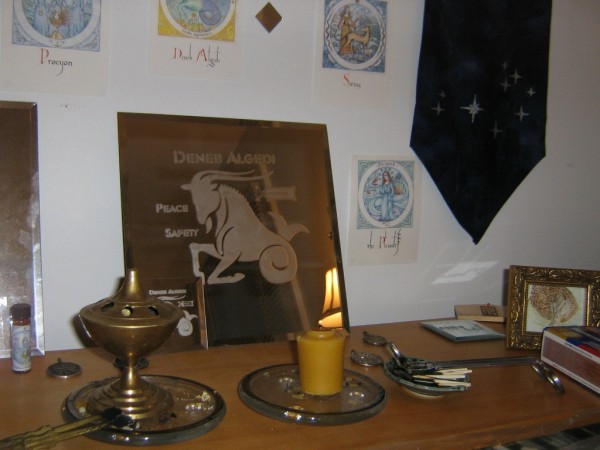
This is a picture of both my large and a small Deneb Algedi mirror on my fixed star altar.

I have three working altars, the fixed star altar and a Mansions of the Moon and planetary altar, this is an slightly older version of the planetary altar with a few non-planets on it.

Wade says that the casting of silver Deneb Algedi talismans went very
well and you can pre-order silver talismans for $199.95 plus shipping

Sunday, September 5, 2010

Which One is the BEST???


In traditional astrology it is not unusual to have variant lists, for example there are many house systems, eg Placidus, Regiomontanus, Porphyry, Campanus, Alcabitius, different lists of terms, eg Ptolemaic, Egyptian, different lists of Mansions, eg Picatrix Bk I, ch 4, and Picatrix Bk IV, ch 9. I am often asked "which is the BEST one?" with the unconscious assumption that there can be only one that is best.

This almost automatic assumption is conditioned by our world view. When science says that cholesterol is deadly, no, a new study says cholesterol is vital for life, no, wait, a new study says cholesterol kills on sight, we seem to roll with that as confusing as it may be, because we have unconsciously accepted scientific objectivism, which holds that there is one, single objective reality out there separate from us and if we eliminate all subjectivity (BAD MONKEY!) we can find the ONE TRUE ANSWER, which we know must exist to all questions.

The typical approach used by contemporary astrologers, both modern and even those trying to be traditional, is to try to be "scientific" and experiment, to test different house systems or lists. One standard method is to look at one's birth chart using different house systems and then decide which one is "most accurate" "Oh, I am definitely more of a Pisces than Aquarius rising!" Of course this is highly subjective, not that I necessarily object to subjectivity, but it is a bit odd to be trying to find "objective" reality that way! Additionally these tests look at an extremely tiny sample, just one's own birth chart is often all that is used, or perhaps a few celebrities or relatives, again suspect from a "scientific" viewpoint.

Finally, the real problem of this sort of testing is one that plagues modern astrology in general. Because modern astrologers are so keen on evolution, progress and individuality, they are constantly inventing new methods, "A NEW TECHNIQUE that REVOLUTIONIZES astrology" It never seems to work for anyone else and eventually stops working for them. We may not necessarily understand why traditional astrologers used a particular technique, but stop using or change and watch your results get more and more inaccurate.

But why are we so intent on finding the "BEST" which must be a single method, good for all time, for everyone. We can look to our modern worldview and objectivist thinking. Since this is our basic modern view of reality, we are therefore confused by the fact that Robert Burns, for example, says, "My love is like a red, red rose" while Shakespeare says, "Love is a smoke and is made with the fume of sighs" Well, which is it? While this is perhaps a bit facetious an answer, here is one a bit closer to the mark, traditionally in Europe white is worn for weddings and is thus a happy color, while in parts of Asia white is associated with funerals and is a negative color. Is white positive or negative?

Where we get confused is classing love and this color symbolism as merely subjective and thus conventional, simply randomly assigned. Or we fall into total relativism, saying that if there is not one single objective reality that all views of reality are equally valid. It seems to me that there is a middle path here, of recognizing that there are a variety of systems, paths and approaches, some better mappings of reality than others, and that we are personally suited to some and not to others. Finding a path with "heart" that is appropriate to you, is our quest.

So, probably the best approach with these variant house systems, Mansion listings, etc., is to follow the shoe size example. My shoe size in the US is 10 in Europe 44. Which is my REAL, CORRECT size? Well if I am buying shoes in Cedar Rapids, 10, in Dusseldorf, 44. If you are using the book I mansion, use them! The book IV mansions, use them! Regiomontanus or Placidus, use either, just pick one and stick with it, don't jump around chart by chart.

New Planetary Charity Page!


I have a new Planetary Charity page.

Planetary charity comes from the Vedic astrology of India and is a great way to work with the energy of planets that are too afflicted in our birth charts to use their talismans.

By doing charity and dedicating it to a planet, we can work with the energy of the planet and help diminish its negative effects on us. Of course, planetary charity is not just for planets that are afflicted in our natal chart, it can be used to good effect with all planets.

In doing planetary charity we time the donation we make according to the nature of the planet we wish to propitiate, making the donation on the planetary day and hour ruled by the planet. We make the donation to a person, organization or thing ruled by the planet and ideally the donation itself is an item ruled by the planet. Typically, however, it is more practical to make a monetary donation. We start by invoking the planet and making a vow to make a set number of donations, at the appropriate time. We then carry out the planetary charity.

Monday, August 30, 2010

Synastry in Traditional Astrology


I had an interesting question recently asking whether "synastry" was used in traditional astrology. Synastry is a modern term for comparing two natal charts and allegedly provides information about the compatibility of the two people usually for romance.

While he doesn't call it synastry, Lilly has a very interesting section in Christian Astrology in the natal section at page 637-9, entitled, "Whether there may be Concord or Unity between two." in other words will two people get along. While this is placed under the 11th house of friends, I have used it for 7th house romantic relationships as well since the techniques are not house dependent.

Lilly says to look at the two natal charts and compare particular factors, in particular he compares the Ascendant rulers and looks to see whether certain planets are at the same location in both charts.

Lilly also uses the traditional concept of the friendships and enmities of the planets, ie Saturn's friends are Jupiter, Sun, Moon according to Lilly and his enemies are Venus and Mars. CA 637. The problem with the friendships and enmities are that there are lots of different and contradictory lists and sometimes you have weirdness where planet A is listed as a friend of B, but then planet B is listed as an enemy of A in the same list. A bit too confusing for ease of use! I've just left this out when doing traditonal "synastry".

Let me say a bit about synastry in general. It is pretty standard in modern astrology because modern is natal, natal, natal and they don't have any other way to try to forecast the specific relationship between two people. As far as I can see there are no generally accepted methods for modern synastry, everyone just makes it up as they go along. As is generally true for modern, typically the answer is that "YES, you are compatible with X! and will live happily ever after"

Couple of problems. First, the lack of set rules and general positive modern outlook heavily biases the modern reading towards a positive answer. Secondly, compatibility is used as a proxy for the question of whether or not the relationship will actually take place or last. The assumption that if two people are compatible, they will automatically be madly in love and thus in a committed relationship is clearly way off base. I used to joke that I am completely compatible with Scarlett Johansson, and I can just hear the wedding bells ringing there!

Horary is really the best method here. It goes right to the heart of the matter and can answer accurately and precisely, "Will I have a committed relationship with X?" Synastry can't answer this accurately even using traditional technique, let alone using whatever passes for technique in modern astrology.

More on Horary Astrology

Wednesday, August 25, 2010

Aspects & Orbs with Non-Planets


I had a very interesting question recently regarding the Moon aspecting a fixed star. The questioner wanted to know whether you used the full orb of the Moon or her moiety, half her orb. Good question!

Orbs are zones of power spreading out from the exact aspect, known as perfection. According to the English astrology William Lilly, in his 1647 Christian Astrology at page 107 the Moon's orb is either 12.5 or 12 degrees. Here is Lilly's orb table.

First off, don't use orbs like a cliff, use them like a gentle slope. Lilly himself says "I sometimes use the one [orb measurement], and, sometimes the other, as my Memory best Remembereth them, and this without error." Christian Astrology page 107. It is not as if the orb of the Moon is fully effective to exactly 12.5 degrees and then at 12.51 degrees we ignore it completely. The closer the aspect to perfection the more powerful, the farther it is the less powerful it is until it basically fades out. Orbs are reasonably flexible rules of thumb. I set the orbs on my astrological software way out so I can see all the aspects the planets are making even if technically out of orb.

Secondly, orbs and moieties. I am told that in modern astrology it is the aspects that have orbs, but in traditional each planet has an orb. This is split in half for a moiety. So if the Moon's orb is 12, her moiety is 6. With aspects of planets to planets you add the moiety of each planet to see if they are in orb. Thus Moon orb 12, moiety 6, aspecting Mercury orb 7, moiety 3.5, 6 + 3.5 = 9.5 orb of Moon/Mercury aspect is 9.5. Again don't just ignore an applying aspect of the Moon to Mercury if it is 10 degrees, it is just a lot weaker than 3 degrees away!

Now when we pass to planets aspecting non-planets like house cusps, Parts, Nodes, fixed stars, outer planets, etc., for the orbs we need to delve deeper into the background of aspects. Aspect comes from the Latin, aspectus, literally looking, seeing or facing. Only planets make aspects, ie, they alone see or face. Similarly, only planets rule signs or houses. Planets are the real actors in the chart. True the signs are sometimes said to "rule" illnesses, parts of the body and places, but I like how Lilly says they "signify" these things, that is they correspond to them, rather than actively rule or cause them like a planet.

So as it always seems in traditional astrology, we have exceptions, however, when it comes to aspects it is solid, only planets aspect. So this means we use the full planetary orb, not the moiety, since the non-planet has no orb and thus no moiety of its own to contribute. Thus if, for example, the Moon was 7 degrees from the Midheaven and as her orb is 12, the aspect is well within her orb.

Treating the planets as the most "active" and in a different fashion from Parts, Nodes, house cusps, etc., is a major difference between traditional and modern astrology. In modern astrology the nuance has been lost and everything acts likes everything else, eg Parts aspect house cusps aspect Nodes, rather than planets being the primary actors.

Thursday, August 19, 2010

Moving Fixed Stars


I had a question recently about trying to get the exact position of a fixed star for an election. This question comes up because the fixed stars are only fixed by comparison to the planets, from the Greek planetos or wanderer, who are bopping all over the place. The fixed stars do slowly move.

Firstly, some astronomy! The planets all orbit fairly close to the plane of the ecliptic, the path of the Sun, but the fixed stars are spread out all over the 3-D sphere of the Heavens. This means that their positions are distorted significantly when they are mapped onto the ecliptic from 3-D to the 2-D of the chart.

Saying this I can feel the modern reaction rising instantly, "ah, we must follow like robots the 'actual' material position of the stars". Not so fast! Now some philosophy. There are ways to use the heliacal rising and setting of fixed stars, Google this for more info, but our system of astrology doesn't use this, any more than Bach needed to use Indian raga quartertones to play incredibly beautiful music or I need German umlauts to write in English. Mapping the fixed stars onto the ecliptic gives us a whole set of "sensitive" points, a way of timing when the spirits of the fixed stars can be contacted, various sets of fixed star cycles in which the physical location of the stars imperfectly reflects more perfect underlying spiritual cycles, archetypes and Platonic forms.

Ok, now some practical considerations. The key here is "imperfectly". So analogous to the way matter imperfectly reflects the Platonic forms, so the ecliptic mapping of the fixed stars distorts their positions somewhat. Then we need to consider that precession, nutation, aberration, parallax and proper motion [google them for more info!] all cause individual differences such that we need to individually determine the Zodiacal location of stars, we can't simply apply a single formula to exactly adjust the current location for every star.

Finally, and I have been mentioning this a bit recently, when we do astrological talisman elections we do a time range, not an exact time, because we can't make a talisman instantly! For fixed stars I tend to use the rough rule of thumb of 3 degrees before and 3 degrees after their conjunction with the Ascendant or Midheaven. The influence begins to build and build as the fixed star moves toward the Ascendant or Midheaven, climaxes, then slowly fades out. It is actually likely more effective to consecrate longer and take advantage of the total range and total energy put out during the range. Anyhow it is not as if we had any choice, until we can work in the twinkling of an eye!

Bottom line is that like being unable to determine exactly when Sunrise happens, there is a point beyond which our attempts to be precise in terms of the exact degree, minute and second Zodiacal longitude of fixed stars simply is not effective. By using the time range, we can be sure that we can covered the most powerful time, even if we can't precisely determine what that is.